Blog
Work automation and machine collaboration

By Rob Leslie-Carter et al
Published in Work&Place Edition 9 – December 2017 Pages 43-51
Tags: automation • artificial intelligence
Two things have happened recently that make the timing of this article on artificial intelligence (AI) particularly serendipitous. The first is the release of an incredible video showcasing the first segment of a steel bridge designed by Arup and MX3D but printed by robots. Amsterdam based start-up MX3D created intelligent software that transforms a robot and a welding machine into a large scale printer, enabling 3D printing of metals on an architectural scale. This new technique provides new opportunities for architects and engineers and has huge potential to reduce the delivery time and amount of material needed to make large structures. The printing and assembly began in March 2017, and the bridge is scheduled to be finalised in early 2018. More information about the printing process can be found at mx3d.com/visitor.
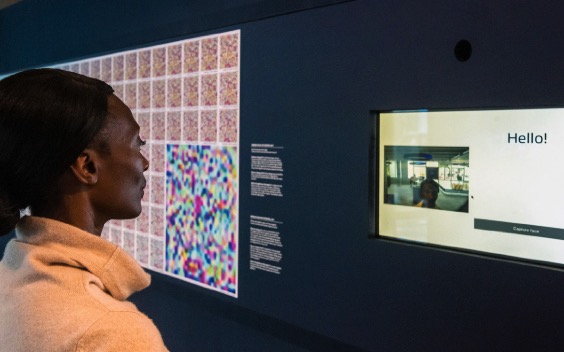
The second coincidence was arriving at our London office to an exhibition in the foyer devoted to AI. The various spaces, robots and screens showcase how new approaches to AI are already revolutionising our lives using real-time data. Visitors experience AI’s strengths and weaknesses, exploring the differences between fully learnt machines or machines learning at the edge, and get to play with some of today’s consumer solutions. The facial recognition screen correctly confirmed who I am (from my intranet profile photo I think), my 20 second cow sketch was sufficiently poor to flummox Google Quick Draw into concluding I’d been attempting a dog all along, and Amazon’s continually learning Echo obeyed my voice request to define ‘machine learning’.
The exhibition is part of Arup’s digital transformation programme, and is dedicated to assisting us to adapt to the rapid changes in AI around us – it runs from 2 October 2017 to 12 January 2018. The exhibits were put together with the collaboration of Arup Inspire, Ambi, Comfy, Autodesk, Google Creative Lab, Manou Mani-Architects, Nvidia, TED and IBM Watson and Yarn. The force behind this provocative event is our global Foresight team – Arup’s internal think-tank which deals with the future of the built environment and society at large.
Human Machine Collaboration – the current picture
The world is changing fast. A wide range of trends and challenges have a direct bearing on the future of work and place. It is vital that we understand these trends, so that we can better manage the risks facing our profession, and make the most of emerging opportunities. Our economy is increasingly driven by project-based work characterised by high degrees of collaboration. Innovation and creativity are the key components of value creation, while employee expectations and working cultures are changing all the time.
We are seeing new forms of working that are enabled by digital technologies, on projects that are both complex and global. Understanding and managing these changes is vital, if we want to continue to provide solutions that truly meet the needs of our clients and stakeholders. Driven by rapid advances in digital technologies, the nature of our work is being transformed. While artificial intelligence and robotics grow more sophisticated, jobs are being reinvented. Collaboration and communication through increasingly intuitive user-friendly interfaces could lead to fundamental changes in workplace structures and may offer new possibilities for productivity and creativity in the workforce. Human-machine collaboration will open the way to virtual and network-based companies as everything shifts online.
Organisations are already reconsidering the shape and composition of their workforce. According to Deloitte, 41 percent of surveyed companies have already implemented aspects of cognitive or artificial intelligence (AI) technologies in their workforce, whilst 37 percent are carrying out pilot programmes. However, only 17 percent of surveyed executives stated a readiness to manage a collaborative workforce of people, robots and AI.
The area with the greatest scope for change is in manufacturing – in the automation of repetitive tasks. In Germany, for example, it is estimated that up to 80 percent of jobs for people with low-level education are at risk from automation, compared with only 18 percent for people with a doctorate degree. It’s a similar story when we look at income levels: in the lowest 10 percent income group, 61 percent of jobs are projected to be at risk, while only 20 percent are under threat at the upper end.
As companies redesign jobs and workforces, questions arise around the eventual limits of automation. Could essential human skills, such as empathy, communication, persuasion, personal service, problem-solving, and strategic decision-making become even more valuable?
In moving towards greater automation, companies will have to rethink the role of people and provide training to prepare their employees for this new work environment. Robots and people work side-by-side at Ford’s Cologne plant, complementing each other’s skills (simple and heavy manual tasks vs creative thinking). Businesses might soon start dividing skills and reframing jobs according to essential human skills and non-essential tasks that could be carried out by machines.
Machine learning graduates to the built environment
Machine learning applications are already ubiquitous in our everyday life. When you log into Facebook and someone has tagged you in a photo that is a prime example of the roots of machine learning, which reside in image and facial recognition. Not only does it recognise that it is your face, but also that you have a human face based on the features and relationship between your pixels and all other pixels in the image.
When you speak to Siri on an iPhone, it ‘hears’ your words using speech recognition. When you use Google Translate the sequence of words you used is likely being translated now by something called a recurrent neural network.
When you open your email (mostly) free of unwanted messages, you can thank machine learning for the spam filter – which is likely powered by a technique which has classified junk from non-junk based on the nuanced features of many millions of spam-classified emails.
When online shopping, or browsing Netflix, recommendations are given to us on what we are likely to watch from an algorithm of people who are likely similar to us, and have made similar choices to us.
While AI encompasses the broader goal of computers that can learn and act, machine learning is much more specific sub-set of AI which can be used for solving well-defined problems. Deep learning is a further extension of machine learning, which expands the concept of neural networks (which are inspired by the functionality of the human brain).
Unlike usual algorithms used to perform specific tasks, machine learning methods are employed to learn how to perform a specific task – learning as more data is provided. Just as we have different learning styles, there are (quite a few) different ways which a machine can learn. These methods can be categorised into either supervised learning (where the algorithms have a training dataset to learn from) or unsupervised learning (where we are interested more in discovering underlying patterns and structure in data)….
Please login to read the full article
Unlock over 1000 articles, book reviews and more…