Blog
The implications of the new workplace for leadership

There is still little research on the relationship between leadership and the office environment. One of the first studies examines how the office environment influences employees� perception of management.
By Christina Bodin Danielsson
Edition 5 – May 2015 Pages 35-39
Tags: office design • management
Office buildings are used to demonstrate economic strength and belief in the future, but also to express corporate culture. The use of architecture for branding is based on the idea that architecture helps people recognize the organization and position it in their minds (Hatch & Schultz, 1997).
Recently, an interest in using office architecture as a tool for internal branding has emerged, due to its potential influence on employees’ behaviour (Appel-Meulenbroek et al. 2010).
However,despite this,we have not seen any interest in office design from a leadership perspective.Therefore,I and two colleagues Cornelia Wulff and Hugo Westerlund,set out to investigate if the office type the employee works in has any influence on their perception of the closest manager and their relationship to the manager.
The results of the study:”Is perception of leadership influenced by office environment?” (2013) are presented here.
Leadership
Leadership can be defined as a process whereby an individual influences others to achieve a common goal (Bryman, 2004).To motivate members to perform at high level is a primary task of a leader (Kozlowski & Klein, 2000).That leadership is related to performance (e.g. Lok & Crawford, 2004; Rosete & Ciarrochi, 2005; Ugboro & Obeng, 2000) is established. But it is also related to employees’ job satisfaction and motivation (Locke & Henne, 1986; Lok & Crawford, 2004) as well as health status, stress levels and sickness absence (Nyberg et al.,Kivimäki et al.,2003; 2008). It is by virtue of this, combined with its relationship to employees’ organizational identification, commitment and turnover (Testa, 2001; Tett & Meyer, 1993) that leadership is recognized as a crucial factor for organizational success.
Historically, leadership research has focused on personality traits associated with successful leadership (Nygren,Bernin,& Theorell, 2005). However, over the past few decades ,the focus has shifted towards the relationship between leaders and subordinates, including leadership behaviours and styles, as this has been found to highly determine managerial success (Hart & Quinn,1993). As a result, theories about leader-member exchange (LMX) and empowerment have been developed (e.g., Graen & Uhl-Bien, 1995; Spreitzer, 1995).
Office design’s influence on employees and organizations
Office architecture’s effect on a variety of factors which impact on organizations has been acknowledged in research. It has for example been found that factors important from an organizational perspective such as employee health and well- being (Bodin Danielsson & Bodin, 2008, 2010; de Croon,Sluiter, Kuijer,& Frings-Dresen, 2005),and sickness absence (Baldry,Bain,& Taylor,1997; Bodin Danielsson et al.,2014) are affected by types of office design. Also factors more directly related to organizational success such as levels of performance and collaboration (e.g.,Becker, 2004; Becker & Steele,1995; Brill et al.,1984; Heerwagen et al.,2004),and creativity (Dul & Ceylon,2010; Mitchell McCoy & Evans,2002) have been found to be related to architecture.This is explained by the fact that distances and layout play an important role for both interaction and relationships (Conrath,1973; Estabrook & Sommer,1972). It has for example been found that daily interactions in an office often do not reach further than on average 18 metres from the employee’s workstation (Sailer & Penn,2009). Who you sit near also determines who you become friends with (Szilagyi & Holland,1980),which in turn may be related to the fact that tangible support in social networks significantly decreases with distance (Mok & Wellman,2007).
Being able to hear and see your manager easily from your workstation will also determine how friendly you perceive your supervisor (Crouch & Nimran,1989).This, combined with the fact that managers rely heavily on face-to-face spontaneous and unplanned meetings (Kotter, 1982) tells us that office design has some impact on leadership.We know however nothing about what role different types of offices play from a leadership perspective.
Office design as a strategic management tool
Architecture has, as described above, mainly been used by organizations for external branding because of its strong symbolic value. But due to the recognition of its impact o factors vital for organizational success, interest has grown in utilising it for internal branding.The recent trend to use office design to enhance the identity of the organization for staff is to some extent a result of greater competition within the global workplace market in which organizations have to compete for talented employees (van Meel & Vos,2001).
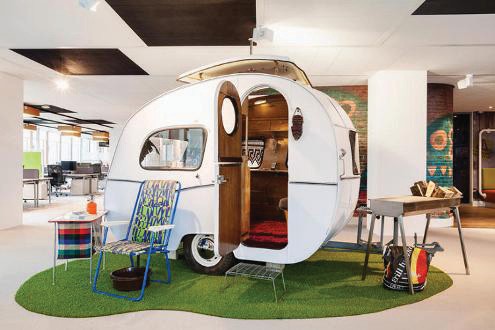
The modern workforce is generally more flexible and less loyal to their organizations compared to earlier generations, and find it less difficult to change employer and country if the work and new employer appeals.This awareness of the importance of using the office environment for internal branding is demonstrated by Google’s use of its offices to attract and retain its talented workforce.
Google’s offices around the world are designed to facilitate work in many different ways, with layouts designed to encourage informal interactions between colleagues. For example, Googleplex, the company’s headquarter in Montview, California, is designed like a university campus, with restaurants, barbecue areas facilities for sports, parties and concerts, and even a nursery for the employees’ dogs. Alongside this, employees are also offered high quality food for free at the workplace.With this growing trend to use the office as an internal strategic management tool, as illustrated by Google, the lack of research so far into the impact of office design from a leadership perspective is difficult to understand.
A study on perception of leadership in office types
Recognizing office design is one of the tools leaders can use to create and change the structure within an organization, combined with the fact that leadership plays an important role for employees’ welfare as well as performance – factors crucial for organizational success – I and two colleagues set out to investigate the office type’s possible influence on employees’ perception of their closest manager.The closest manager is of specific interest, since he/she directly affects the subordinates’ work situation (e.g.Deluga, 1998; Graen & Uhl-Bien, 1995)
Our aim was to adopt a holistic approach to the subject, since the office environment is characterized by physical, psychosocial and organizational factors, which together create the overall environment.This includes attention to aspects such as privacy, spacious openness, group size, i.e. architectural features of the office, but also attention to functional features such as organization of work, various functional and technical (ICT) needs….
Please login to read the full article
Unlock over 1000 articles, book reviews and more…