Blog
The ambiance of ambience: How artificial intelligence changes occupant experience

As artificial intelligence becomes embedded in buildings, spaces, and equipment, a new paradigm for the interaction of people and place is emerging.
By David Karpook, first published in Work&Place Issue 11 – Spring 2019 pages 50 – 59
Tags: AI • human resources • automation
If a robot received a signal that you had entered the building, it might bring you a fresh cup of coffee just as you reach your desk. If the front door recognized your face, it might unlock itself for you without requiring you to use a fob to gain access. If your desk knew you had left for the day, it might offer itself to a colleague who is looking for a quiet workspace.
Throughout history, the interaction of humans with technology has been pretty much one-sided. We turn our technologies on and off, operate and guide them in their tasks, and use our senses to monitor their functioning and detect anomalies.
But over the past few years, the nature of that relationship has started to change. More and more, our technologies hear us and see us, and take actions without our explicit intervention. Developments in what we call artificial intelligence have been rapid, and they can be unnerving.
Ambient technologies
Artificial intelligence today is a combination of the practical, the plausible, and the potential. Some of its most interesting manifestations can be classified as “ambient,” meaning that they exist as embedded features in our environment, operating without us having to pay particular attention to them. They rely not on keyboards and screens but on our voices, our movements, and our physical features.
Andrew Ng, the former chief scientist at the Chinese company Baidu, one of the world’s largest artificial intelligence firms, has said that, “AI is the new electricity.”[i] The analogy is compelling. Electricity is so ubiquitous as to be a virtual necessity. When electric power is needed, we assume that we will be able to find a source on the nearest wall; when it is not available, we feel as if civilization has left us behind.
Although it is still in its infancy, there are reasons to suspect that artificial intelligence, particularly in its ambient forms, could develop in ways that eventually make it ubiquitous and necessary in similar ways.
Current experience is telling us that the AI revolution is taking over quietly, and it is becoming an aspect of daily experience without us really being aware of how dramatic the changes are. We talk to our cars, telling them where we want to go, and they respond by giving us step-by-step directions. More and more of us are speaking in conversational syntax with our phones and with devices in our homes to seek information, make appointments, operate appliances, order food, and purchase consumer goods.
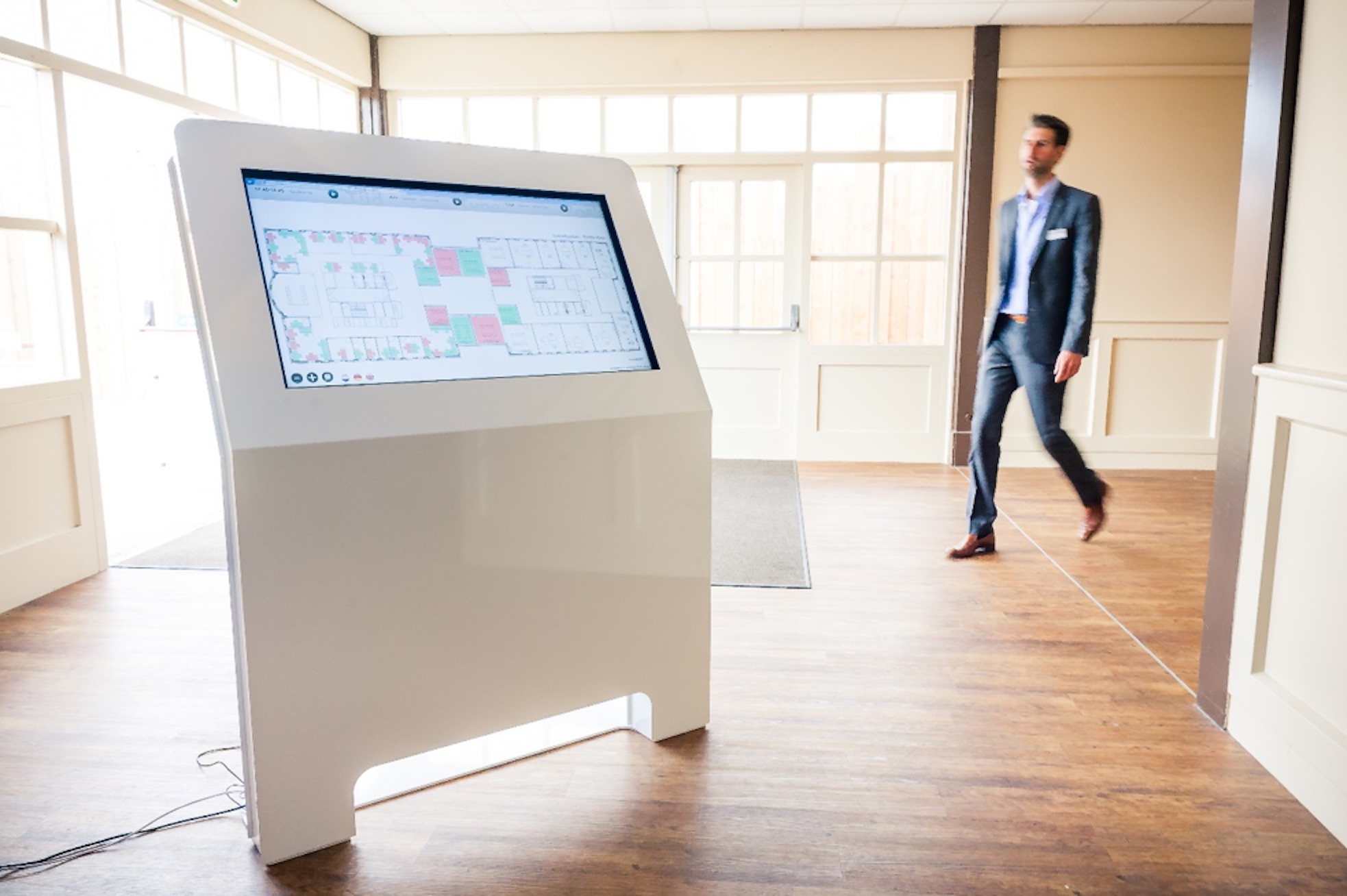
Figure 1:
A smart kiosk working in tandem with occupancy sensors can highlight available workspaces for nomadic workers.
This article’s opening scenarios for building behavior are far from outlandish. Consider the following:
CafeX, at two San Francisco locations, has replaced human baristas with talented, ever-improving robots.[ii] They don’t deliver to your desk yet, but CafeX has targeted corporate office settings in its expansion plans.
Cloudastructure is one of many companies offering facial recognition-based access control systems. Cloudastructure’s system matches a learning application for face recognition with more traditional access technologies, such as card readers, to provide a multi-layered identification system. Over time, the system learns to recognize a person in different lighting, clothing, hairstyles, and so on.
Facility management software vendors such as Planon (my employer) have integrated their space management functions with occupancy sensors that allow unused space to be displayed on kiosks and mobile devices so that they can be reserved and used, as well as released for rebooking when an occupant leaves.
Ambient intelligence, as an extension of artificial intelligence, is being enabled by a cluster of emerging technology developments including:…
Please login to read the full article
Unlock over 1000 articles, book reviews and more…