Blog
Smart cities, smart buildings and the growing allure of infinite data

There needs to be greater awareness of the velocity of workplace innovation, the growth of smart Cities and their market effect on the architecture, engineering, construction and facility management industry.
By Paul Doherty
Edition 5 – May 2015 Pages 28-31
Tags: smart cities • building information management • big data
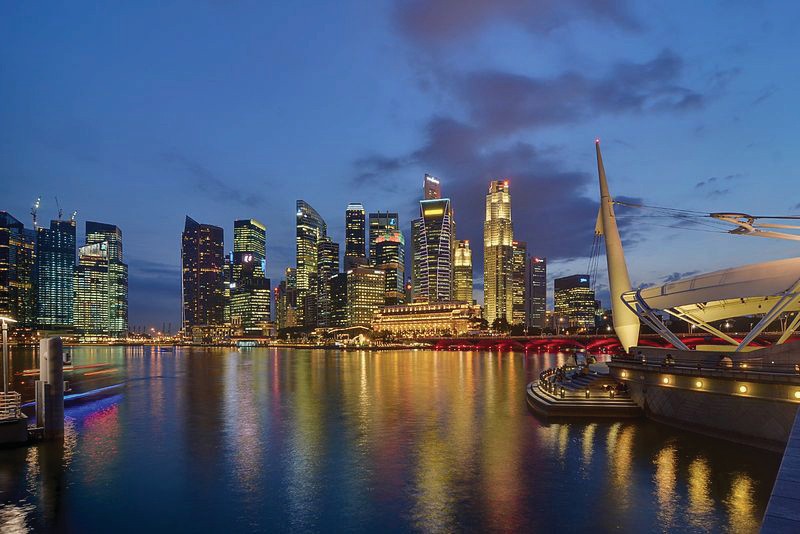
Image: The main business district in Singapore
The rapid urbanization of our world and the weaving of buildings into the fabric of Smart Cities are some of the great challenges facing our industry today.
Along with the vast amount of definitions and marketing campaigns surrounding the phrase “Smart Cities” comes the challenge of understanding why the movement is important to the Architecture, Engineering, Construction and Facility Management (AEC/FM) industry and how its stakeholders can profit from, or at the very least, not get swept away in the tsunami. The emergence of Smart Cities as the conduit for ideas, thoughts, policies and strategies for urban environments is an important milestone for our industry, and it comes at a time of rapid innovation, convergence and redefinitions.
Urbanization
Before diving into the numerous definitions of a Smart City, it is important to understand the underlying forces driving this movement, from ideas and concepts into actionable projects and programs. The unique timing of market conditions, technology innovation, social wants and government needs and the global migration to urban environments that dwarfs any mass movement of people in history; are the forces that are converging to create the Smart City tsunami.
Cities are exploring their options, led by the competitiveness between cities to attract and retain top talent and businesses and provide quality public services while balancing a budget. This exploration through innovative projects and programs is giving rise to a context called Smart Cities.
In 2008,the United Nations reported that the world’s population living in urban areas rose above 50% for the first time and is expected to reach 70% by 2050. If true, the world’s urban population will reach 5 billion by 2030. Using only 2% of the entire planet’s land mass, cities are using 75% of the world’s natural resources which account for about 80% of the planet’s greenhouse gas emissions. Cities are moving to a Smart City agenda not because they want to, but because they have to.
Due to the local priorities and needs of each city, there are numerous emerging definitions of a Smart City. The flexibility of this definition provides cities with the opportunity to define their own programs, policies and procedures according to local priorities and needs. Smart City definition frameworks are designed and marketed by academics, companies, urban associations and then reported in the media. Most of these frameworks have projects and programs that include Smart Grid, Smart Buildings, CleanTech and Smart Governance.
Through these frameworks, a foundation has emerged that helps define areas of Smart City interest, action and measures. Most frameworks use the SMART acronym to define Specific, Measurable, Achievable,Relevant,and Time-based goals.
Most of today’s cities are running on independent, multiple departments, which can be associated with “Operating Systems”, designed to optimize a specific service in an expert system manner. The goal of efficiency and effectiveness for a city to grow into a Smart City is to provide conduits of how these different Departments/ Operating Systems can work and learn together, sometimes through integration and collaboration and other times through interoperability.
The ten common Areas/Departments/Operating Systems that are seen as leading indicators of Smart Cities include:
Transportation
Infrastructure
Energy…
Please login to read the full article
Unlock over 1000 articles, book reviews and more…