Blog
Designing the workplace to unleash everybody’s full potential

The onus is increasingly on employers to create environments that generate
positive workplace experiences and provide workers with the tools to boost
wellbeing, engagement, and performance
By Jo SutherlandIssue 11 – Spring 2019 pages 10 – 12
Tags: events • workplace design • productivity
Experience matters
Workplace Week London 2018[i], the brainchild of AWA, took over the capital last October to shine a light on the organisations that are putting much more thought into how they create an excellent workplace experience. More than twenty organisations, including ten debutants, opened their doors to the public for the very first time, including some of the world’s biggest banking, travel, technology, media, creative. and professional services firms.
“Workplace Week was created in 2011 to showcase how business leaders and their facilities, people services, and workplace teams can champion change in order to improve engagement, productivity, wellbeing, and business performance,” says Mawson. “Over the years, the week has explored how organisations are using workplace change as a tool for business transformation by embracing new, modern approaches to work to help people be at their best.”
AWA and Interserve’s most recent report – “Designing and Delivering Effective Workplace Experiences”[ii] – argues that experience is not just about the physical workplace and its ability to satisfy the functional needs of the user. It is about the way each and every interaction within that space has a bearing on that employee. In the war for talent, employers must cater to the demands of their workplace consumers or lose out to the competition.
Following twenty-eight ‘working workplace’ tours conducted as part of Workplace Week, it seems the workplace experience encompasses four key areas: health and wellness, collaboration and connectivity, courageous cultures, and diversity and inclusion.
The workplace consumer
In the early eighties marketers Morris Holbrook and Elizabeth Hirschman conducted a study looking into the experiential aspects of consumption, focusing on how the customer experience impacts purchasing decisions. They discovered that an experience occurs on a number of different levels and happens largely without customers being consciously aware of the interactions that are driving their responses.
A decade later, Joseph Pine and James Gilmore, writing in the Harvard Business Review,[iii] hypothesised that customers’ experiences are defined not just by the product or service they are buying but also their internal responses to every interaction they have with that organisation. More recently, Italian researcher Chiara Gentile[ii], channelling Holbrook and Hirschman, proposed that an experience encompasses the rational, the emotional, the sensory, the spiritual, and the physical.
The ‘employee experience’ discourse enveloping the workplace world reiterates the industry-wide belief that one’s surroundings influence one’s behaviour. The dictionary definition of “experience” is “an event or occurrence which leaves an impression on someone.”
However, Andrew Mawson, founder of global change management firm Advanced Workplace Associates (AWA), having joined forces with Interserve to analyse over 100 scientific studies into the customer experience and its impact on behaviour in order to draw parallels and apply the learning to the workplace arena, argues that it goes much, much deeper than that.
“Workplace management is about designing and delivering multi-faceted, minute-by-minute, multi-sensory experiences that create an emotional response,” says Mawson. “It is about designing workplace experiences in much the same way a retailer would, considering every second to deliver a specific ‘mission’. It encompasses thinking about journeys and destinations, the fusion of space, information, services, and how these reflect organisational personality, support human effectiveness, and are attractive to target employees.”
Highlights from the tours
Seven wins
The Crown Estate’s head office, located on the first and seventh floors of No 1 St. James’s Market, is the first ever WELL platinum-certified building in Europe.[v] Through 102 performance metrics, design strategies, and procedures, the WELL Building Standard (WELL) looks at all components of a building and analyses how these could affect an occupant’s health and comfort. It focuses on seven areas: air, water, nourishment, light, fitness, comfort, and mind.
Crown Estate embraces WELL’s heptagon. The building promotes optimal indoor air quality; the lighting scheme maximises natural light and minimises disruption to the body’s circadian system; there is a safe and clean water supply; the integration of physical components supports an active lifestyle; the design of the space promotes a productive and comfortable environment and optimises cognitive and emotional wellbeing; and, thanks to its partnership with London contact caterer Vacherin, there is an exceptional nourishment programme that encourages healthy eating habits and food culture.
Building bridges
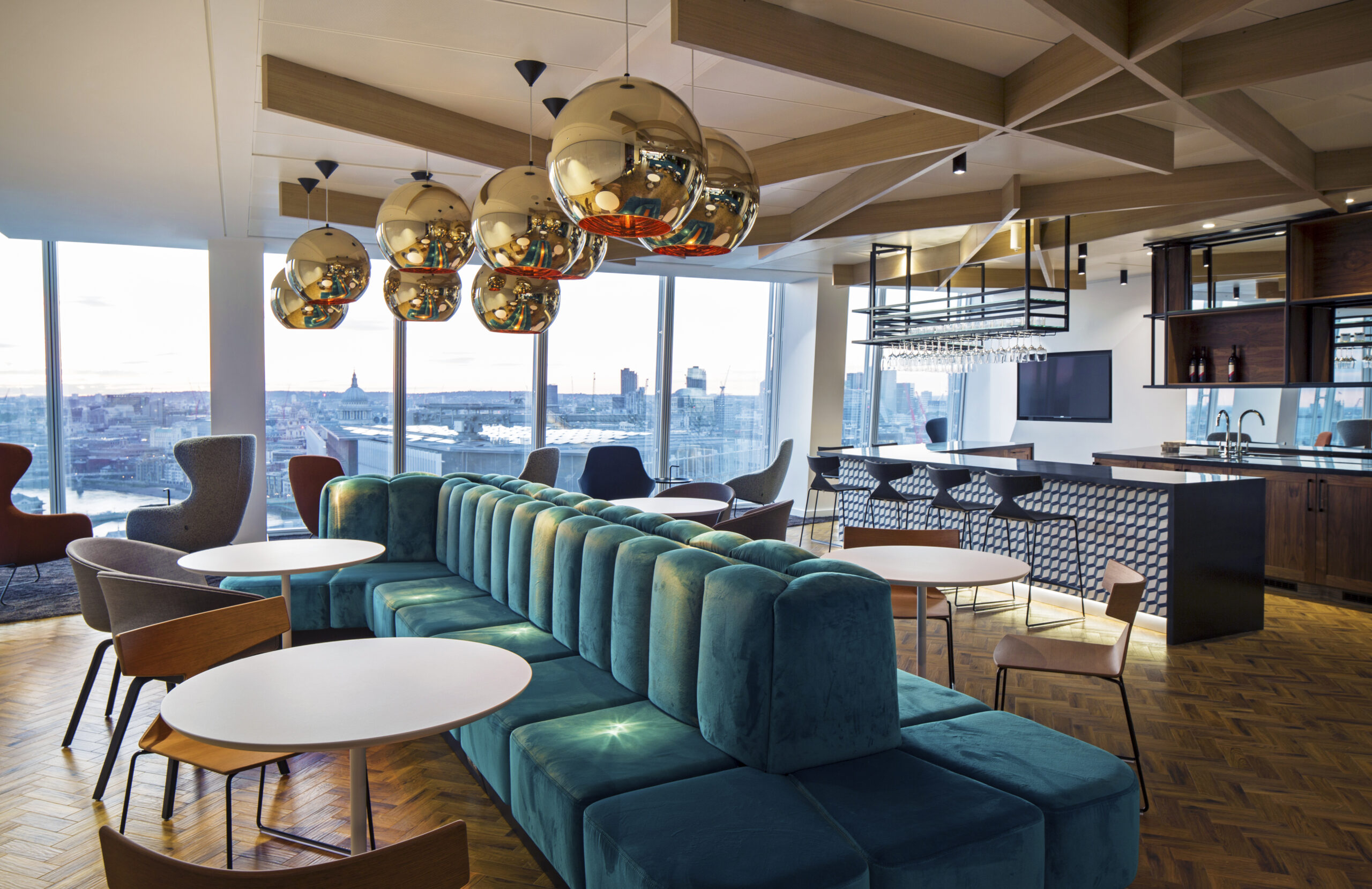
Digital marketing agency Jellyfish has recently expanded to new heights within the UK’s tallest building. With UK offices in Reigate and Brighton, the Jellyfish crew can also choose to work on the 22nd and 28th floor of The Shard (a 95-story supertall skyscraper in London, the tallest building in the UK).
…
Please login to read the full article
Unlock over 1000 articles, book reviews and more…