Blog
Cornell University’s research on leadership, workplace transformation and new cultures

The ability to respond to change is one of the most widely cited prerequisites for success in the modern business world. When it comes to implementing change it�s worth remembering that culture eats strategy for lunch.
By Rebecca Booth
Edition 5 – May 2015 Pages 12-13
Tags: leadership • management
Today’s organizations are in constant flux with continual pressure to evolve. Whether the demand originates from organizational restructuring,technological adaptation, competitive pressures,economic constraints,environmental or productivity improvements,it affects people and the built environment. Only about half of transformation initiatives accomplish and sustain their goals,according to a survey on Culture and Change Management by the Katzenbach Center.Among the biggest obstacles to successful change leadership is “change fatigue”1,which is marked by empathy and failure to engage in the change agenda. These barriers pose a challenging arena for a leader to motivate change and maintain the momentum needed to meet the business goals of the organization. Change leaders are in need of methods to inspire supportand energize stakeholder commitment
to improve the success of
change implementation.
Leveraging culture to provide
a sense of a liation, motivate
commitment and to exist as a
basis in formulating the vision
has powerful potential to
improve the success of change implementation.
Change management or change leadership?
Change Management is focused on the structure,order, efficiency and control of the initiative with an emphasis on timeliness,budget,and encouraging people to adapt to smaller scale change. Alternately,Change Leadership,empowers action that inspires change on a larger scale by motivating people to work as a unit throughout the process to define a vision and shape the transformation collaboratively. There is improved risk tolerance when engaging to Change Leadership because
of the energized approach and holistic nature of the process versus the traditional Change Management approach.
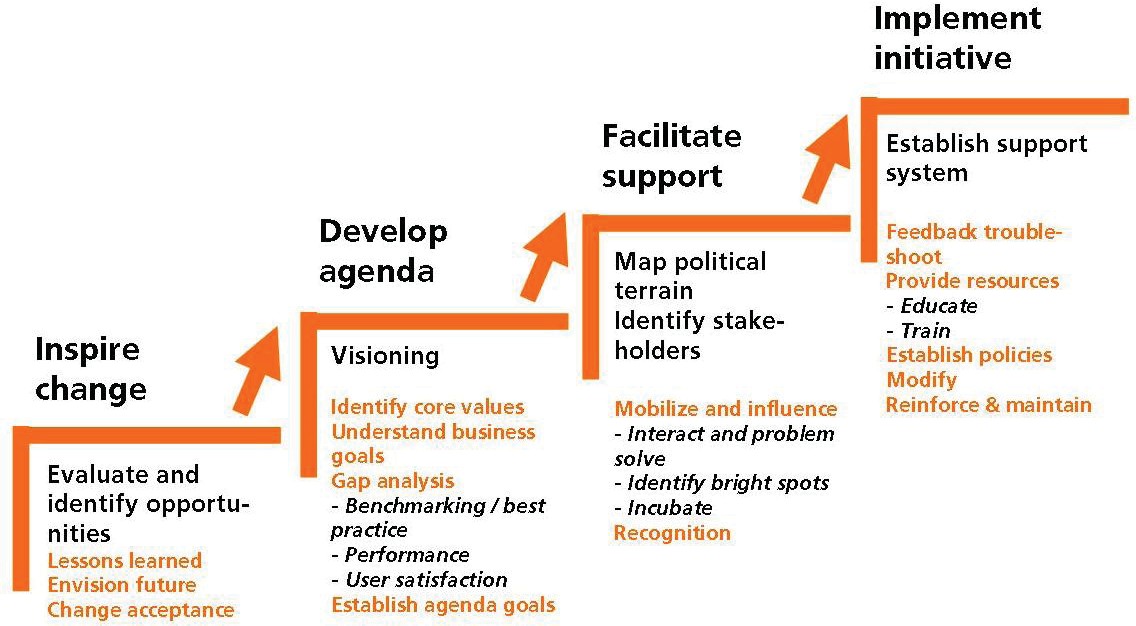
There are four fundamental phases to Change Leadership that are vital to the success of any managed change initiative which include:
Inspire Change
Develop an Agenda
Facilitate Support & Maintain Support
Implement the Initiative
Phase I: Inspiring change
The first phase of change leadership involves evaluating the arenas for action within your organization,by initially identifying areas in which improvements can be made to optimize efficiency or performance and secondly,focusing on the gaps or opportunities to enable organizational members to understand and accept change as a benefit. Assessing the change environment of your organization and understanding the nature of your organization is beneficial in creating an agenda that inspires acceptance for change. Developing an awareness of the pace,patterns,limitations and capacity to embrace change is instrumental in the development of a successful agenda. Commitment to the change agenda is further strengthened by conveying a concept of the optimized future state of performance or efficiency. Companies that are the most effective at change implementation are 4.5 times as likely to involve change and internal communication professionals at the earliest stage of planning – when they are identifying the problem or opportunity.2
Phase II Developing an agenda
One of the most-accepted ways to facilitate support for the agenda is to create a vision. A vision is a stable identity that is tied to values and purpose,which connects to the bigger picture of the organization’s goals. A well-crafted vision engages members to achieve a common goal through a shared sense of purpose and exists as the foundation of reasoning behind the agenda.
How does culture leverage change? Culture is the very mechanism by which you motivate people to commit,to identify, and to integrate with the organization3. A recent study from PWC highlights the need for a more culture-oriented approach to change. The findings also suggest strong correlations between the success of change programs and whether or not culture was leveraged in the change process.4 Organizational culture is strongly influenced by core values and vision because they represent the guiding principles and manner in which the mission is achieved. PWC concludes that cultural levers were at least twice as likely to have played a role in change management that had succeeded5. One way that culture can be leveraged to effectuate change is to model solutions that reflect key attributes of the organization’s core values and vision. The chart below lists some common core values,their attributes,the behaviors they motivate and a few associated solutions.
…
Please login to read the full article
Unlock over 1000 articles, book reviews and more…