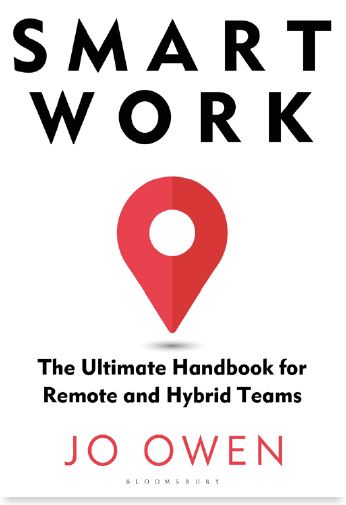

Jo Owen’s bio is impressive, including having “worked with over 100 of the best, and a couple of the worst, organisations on our planet”. A former Partner at Accenture, more recently he founded eight NGOs; for one of which, Teach First, he was awarded an OBE. But, does he write ‘good reads’? The answer may be revealed early, as he claims the honour of being the only person to win the Chartered Management Institute Gold Award four times for his books.
Having been writing about leadership, and management practice, for many years, Jo Owen cannot really be accused of jumping on the post-pandemic wave of media concerning ‘remote’ and ‘hybrid’ work. Instead, he has analysed what has worked in the past, versus what has changed – as he says, “remote and hybrid working is not a temporary shift: it is a paradigm shift”. So the result is a well-structured guide, for all of us, as we work to a greater or lesser extent in remote teams, with colleagues whom we most often ‘meet’ via one of many video-conferencing platforms. This paradigm shift has been harder for some than for others, and Jo provides insights into “how the pandemic shook the management sector” in particular.
“Smart Work” is not only aimed at leaders; it is also for all managers and their teams. Remote and hybrid working was ad-hoc in most organisations prior to Covid-19 spreading around the world in early 2020. The way we need to work now is unfamiliar for many people, and uncomfortable for some. Whilst senior leadership teams have seized opportunities to change, “many managers can be poorly equipped” to deal with the changing world of work thrust upon them.
What can you expect from this book? As Jo makes clear, it is “deliberately short on theory”. It is a handbook, to help the reader to understand the post-pandemic change, identify typical current challenges, and some ways to tackle these issues. It is not an MBA textbook with complex diagrams, models and academic phrases. It is more like having a wily old mentor in book form; someone who has talked to dozens of organisations and leaders, summarized it, and written it down for his mentees. As Jo says, the book “focuses on what is working in practice around the world and in hugely varied organizations”.
The handbook explores several key questions:
How to split time and work, between home and office
How to communicate and co-ordinate remotely
How to build the correct ICT structure to support remote working
How to have effective meetings
How to manage time and workloads
How to sustain intrinsic motivation when working remotely
How to deal with stress and burnout
How to achieve some work-life balance
How to manage the conflicting needs of different employees and different types of work: “not all work and not all staff are suited to hybrid or remote working”
‘…hybrid and remote work is here, so let’s deal with it together’.
The latter point is important, and typifies the approach taken in this book – it is not evangelically espousing remote working. Rather, the book is pragmatic – i.e., ‘hybrid and remote work is here, so let’s deal with it together’….
Please login to read the full article
Unlock over 1000 articles, book reviews and more…