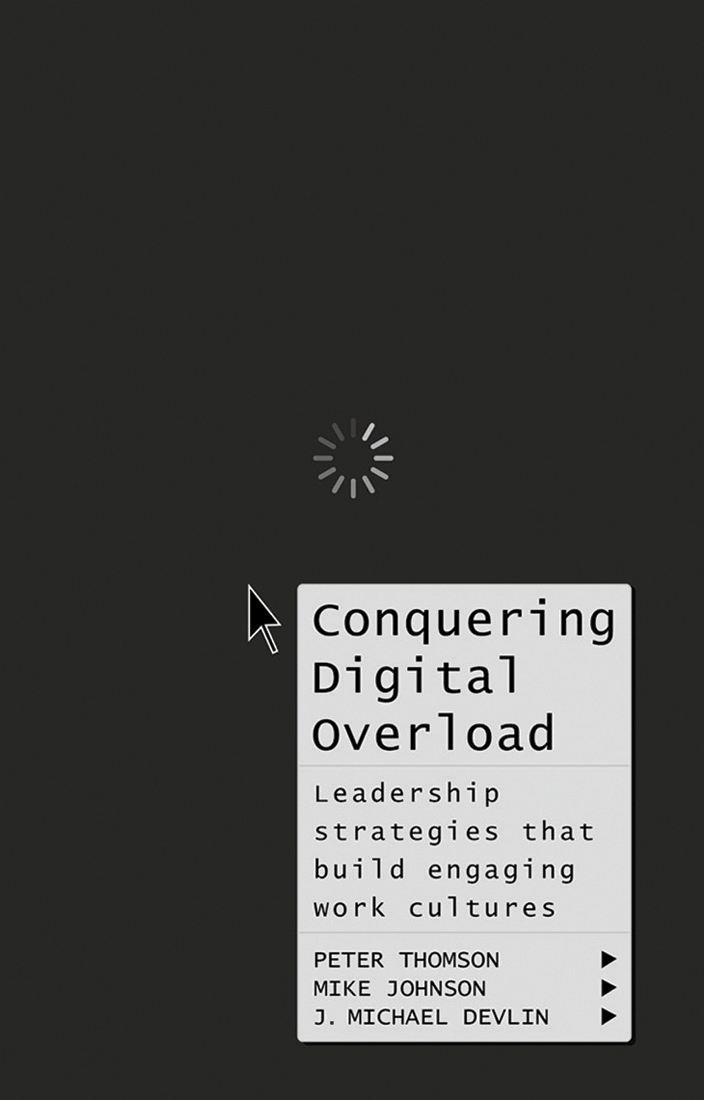

This book provides guidance to everyone experiencing the “digital overload” that comes from being always on and subject to the increasingly rapid pace of change
Tags: technology • stress • digital overload • leadership
Conquering Digital Overload: Leadership Strategies That Build Engaging Work Cultures is a twelve-chapter work co-edited by Peter Thomson, Mike Johnson, and J. Michael Devlin. The sixteen authors of those twelve chapters each take on an aspect of digital overload and suggest possible solutions. These experts are brought together by their membership in the FutureWork Forum, a group that has been meeting for the last twenty years to discuss and work together to provide leadership as we build our futures of work.
The authors tackle digital overload from a wide set of perspectives. They argue that the experience of overload is triggered by a combination of being always connected/always on, and the pace of technological change more broadly. The authors describe effects felt at all levels, from individual to societal and suggest that, in the workplace, “…most organizations use twenty-first century technology, but with an operational twentieth-century mindset, processes, and organizational structures” (p. 6). They note optimism, however, given more organizations are thinking explicitly about their digital strategies.
I agree with the authors that issues of technology and our lives and work cannot be addressed using a single silver bullet. You need to think about more than just the technology tool or even your organization’s digital strategy. You need to think and design work around all your resources. In the most recent rendition of my own approach, I describe this as “Thinking in 4T” (expanding beyond how we see in 3D):
The Four T’s
Target: project and/or task goal;
Talent: people working toward – and against
– the target;
Technology: everything from texts to hard automation and robots, to basic bots and machine learning – all the tools you have at your disposal; and
Technique: the organizational processes pulling together the work of the talent and technology
To the extent that each chapter hits upon some version of the 4Ts, I’m certain that individuals, managers, and executives will find value as they read. I do, however, wish I could have found a common definition of digital overload, or if a single definition wasn’t possible, a summary of the different views. Given my background and biases, I also would have appreciated more clarity that overload is experienced given some particular combination of target, talent, technology, and technique in a particular situation, rather than a certainty.
Human agency in our experienced overload is acknowledged throughout the chapters. For example:
“… one of the challenges identified by those we spoke to in the course of researching this book is the tyranny of our default notification settings. Without a proactive approach, we are subject to the notifications and noises determined by the software developers. And it’s not always clear whether they have our best interests at heart!” (p. 49).
And later:
“while the technologists are trying to make IT less interruptive, for me, the answer is not a technological one, but a cultural one. To improve the way we use technology, we must first change the way we perceive it. Frankly, we all need to grow up a bit!” (pp. 147-148)
I take this to mean that whether we are technology designers or a designer of work or organizations, people are at the heart of these designs. We need to acknowledge and be responsible for our designs — and learn to design in a way that doesn’t push us toward digital overload.
A Design-Focused Approach
[bs-quote quote=”Doug Engelbart worked on designs that focus on human augmentation rather than the narrower concept of automation.” style=”style-17″ align=”left” color=”#a80000″][/bs-quote]…
Please login to read the full article
Unlock over 1000 articles, book reviews and more…