Blog
How evidence based design is reshaping the very world around us
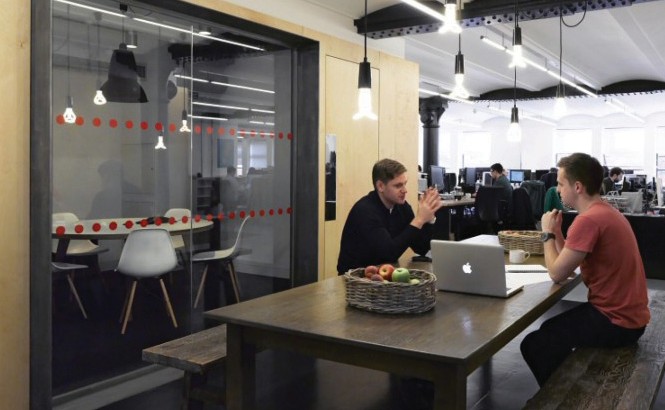

In practice, most workspaces are still based on the experience and intuition of architects and designers, who come up with a design solution with only minimal input from occupiers.� While this produces satisfying results in some cases, the bigger picture suggests otherwise.
By Kerstin Sailer, Ros Pomeroy, Rosie Haslem
Edition 5 – May 2015 Pages 06-09
Tags: human resources • flexible working
In theory, knowledge from a growing body of research could be used to inform workplace designs. In practice, this is rarely the case. A survey of 420 architects and designers by the Evidence-Based Design Journal (EBD Journal 2014) found that while 80% of respondents agreed more evidence was needed on the impact of design on occupiers, 68% admitted they never reviewed literature and 71% indicated they never engaged in any sort of post-occupancy evaluation (POE). Only 5% undertake a formal POE, and even fewer, just 1% do this in a rigorous fashion. Not a single practitioner reported a repeated second round of analysis of a finalised and occupied design scheme, despite scholars highlighting the importance of a pre- and post-occupancy study setup in order to be able to understand the impact of a design solution (Sailer et al. 2009).
In practice, most workspaces are still based on the experience and intuition of architects and designers, who come up with a design solution with only minimal input from occupiers. While this produces satisfying results in some cases, the bigger picture suggests otherwise. In the latest issue of the Leesman Review (Leesman 2014), only just above half of all respondents (54%) agree that the design of their workplace enables them to work productively, which means that roughly half of the workforce perceives office design as a barrier. Therefore additional insights are needed into which spatial features support productivity, satisfaction and staff wellbeing.
Intuition does not always get it right.
From more than ten years’ experience of analysing behavioural data in workplaces, we know that data sometimes confirms commonly held perceptions and beliefs, but sometimes it can also unearth new views and help to bust a few myths. Intuition does not always get it right. Therefore, the use of data in the design and briefing process substantiates decisions with facts and figures, and enables open discussions between the design team and the occupiers. This mirrors what Jim Barksdale, former CEO of Netscape once said: “If we have data, let’s look at data. If all we have are opinions, let’s go with mine.”(as quoted in: Schmidt and Rosenberg 2014)
Based upon both UCL’s research into the science of the workplace and the evidence-based design practice of Spacelab, we have collated ten insights about organisational behaviours, perceptions, cultures and spatial design that might be surprising, new, or counterintuitive.
The majority of contact in the workplace is unplanned.
In four different companies, across various industries (media, advertising, public sector, legal),unplanned contact was found to be much more prevalent than planned contact. Only 34% of all interaction took place in a planned way, while the vast majority occurred ad-hoc and spontaneously (most often at someone’s desk). Sorting things out as and when they arise can improve productivity – the quantification of this effect was recently labelled ‘collisionable hours’, i.e. the number of probable interactions per hour, per area (Waber et al. 2014). For workspace design this means we need to focus more on those spaces that allow people to interact with others spontaneously rather than just design spaces for planned contact.
Silence is not golden: the typical interaction rate in a knowledge-intensive business is 34 percent.
Knowledge-intensive work is characterised by a high degree of complexity and interdependency of tasks and job roles. Most of us do not accomplish things on our own, but rather we often rely on colleagues to contribute. This interdependency requires increasing amounts of coordination. Data from observing more than 200,000 instances of behaviour in 17 different organisations shows that on average 34% of all people present in the space are interacting face-to-face at any one point in time.
However, interaction rates differ significantly by industry. In software development 46% of people interacting at any one time on average, followed by 39% for both advertising agencies and the financial industry; law firms and media companies were the least chatty with 29% and 27% rates of interaction respectively. This brings considerable challenges to workplace design, since office chats are also a potential source of noise and disruption.
Out of sight, out of mind: daily contact remains within the limits of a floor
In the 1970s, researchers at MIT first established that distance has a strong influence on who we talk to most frequently in the office: those within a reach of around 20 metres (Allen and Fustfeld 1975). Being on a different floor was mentioned, but its impact was not quantified empirically. Our benchmark data on the network structures of 16 organisations (collected via staff surveys) show that daily face-to-face contact remains within the limits of a floor to a staggering degree: on average 78% of ties span between people accommodated on the same floor. In three cases it was even 90% or more. When designing workplaces and choosing the right property, it has to be acknowledged that ‘out of sight’ often means ‘out of mind’ and this can have a significant
impact on collaboration
efforts and the amount of
knowledge sharing in an organisation.
Bump into colleagues in the corridor? Not really…
Despite commonly held perceptions that interactions tend to take place in corridors, observational data of 24 buildings show that corridors play a minor role, if we account for the area they make up.
It is often argued that corridors play a big role in fostering interactions. For instance, in an analysis of the famous Bell Labs, where it was purported that “traveling the hall’s length without encountering a number of acquaintances, problems, diversions and ideas was almost impossible. A physicist on his way to lunch in the cafeteria was like a magnet rolling past iron filings.” (Gertner 2012: SR1). Despite commonly held perceptions that interactions tend to take place in corridors, observational data of 24 buildings show that corridors play a minor role, if we account for the area they make up….
Please login to read the full article
Unlock over 1000 articles, book reviews and more…