Blog
Finding the place that is just right for that meeting

Changing the place people meet changes the conversations they have, so the design and managament of meeting space is now a strategic challenge
By James Ware
Edition 8 – Winter 2016 Pages 16-19
Tags: corporate real estate • employee engagement
Every physical setting sends distinct signals to meeting participants – signals that set the tone and provide a context for the conversation, even when they are subtle or not in anyone’s conscious awareness.
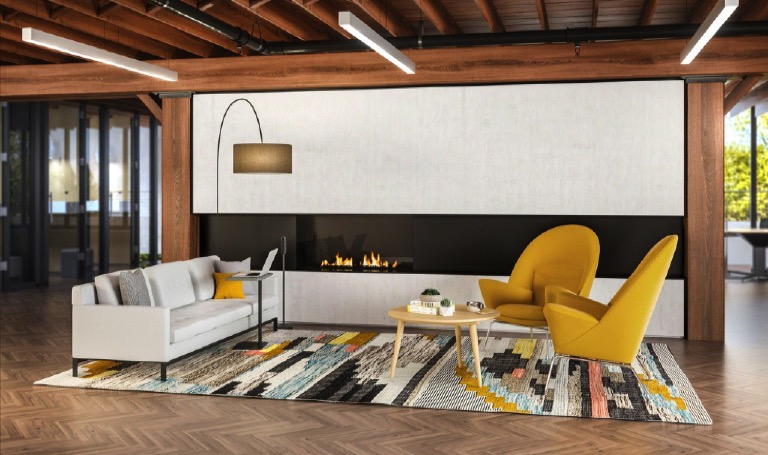
You understand instinctively that the place where a meeting occurs has an impact on the nature of the conversation. Just imagine the difference between a conversation around a large formal conference table with expensive executive chairs and one that takes place in an informal employee lounge, with the participants seated in a circle on soft bean-bag chairs.
Or consider the classic image of a boss seated behind a large desk, in front of a large window framing her silhouette as she delivers a performance review to a “lowly” subordinate sitting across the desk in a low, hard-back chair. Now think about that same performance review being conducted on two softer wing chairs of equal height, with a low coffee table between them. Or in a nearby restaurant or coffee shop. Or on a trail in the woods adjacent to the corporate office. Which of those conversations do you think will evolve in a more caring, respectful, and supportive mode?
Place matters.
However, having choices about place matters even more.While many of us who are knowledge workers move around frequently from one workplace to another, finding “the place just right” for getting a particular task done is often difficult. Sometimes we need a quiet place and sometimes we want to engage with colleagues informally, while at other times we attend meetings with either focused group decision-making or open-ended brainstorming agendas. Each of those activities works best in a different physical setting.
Okay, that makes sense. But how does the design of the workspace affect your mood, your creativity, your ability to concentrate? More importantly, how does place impact the nature and tone of your conversations? And how does a change of place change a conversation?
Change the Place, Change the Conversation
Several years ago one of my business friends inherited a staff of civil servants who were “retired on the job.” They were disengaged, bored, putting in their time, and not particularly focused on performing. Gloria Young was at that time the Clerk of the Board of Supervisors of the City and County of San Francisco. That meant she was essentially the Chief of Staff for the Board; all the city employees supporting the Board reported to her.
Young developed a multi-faceted strategy for addressing her staff’s malaise. She prepared formal, written job descriptions that included performance goals and metrics which she did collaboratively with the individual job holders, so the descriptions, goals, and metrics reflected their knowledge of their own responsibilities as well as hers.
Young also developed a “shadowing” activity that quickly became a cross-training and succession-planning program. Selected individual employees would spend a day or so a week actively observing, following, and “shadowing” one of their colleagues at work. This process not only helped the “shadower” learn a new job, but at the same time it helped the “shadowee” understand his or her job more completely.
Often during the shadowing process the shadower would stop the shadowee to ask a question like, “Why did you just do that?” or “Why are you filing that document in that drawer?”
Those conversations not only helped the shadower understand exactly what was happening, but they usually forced the shadowee to reflect on the work task, and the ensuing conversation often led either to deeper understanding of what needed to be done, or to a conscious redesign of the work.
These new conversations created a revolution within Young’s team. Her staff learned to think much more actively about their own work as well as what their colleagues were doing. Details about work flows, procedures, and skill requirements were out in the open – there for all to see, to comment on, and to learn from.
But the most significant change that Young introduced – one that quite literally transformed the nature of the conversations in her department – was her purchase of a dozen inexpensive canvas folding chairs.
Why folding chairs?
It had become obvious to Young that her team was mired in a set of routine habits that were relatively unproductive. Staff meetings were often uninteresting, low-energy, and full of issue avoidance. No one was engaged; the meetings felt like a waste of time, especially to her.
The staff meetings had traditionally taken place in the department conference room, which was a classic design: a big wooden table surrounded by uncomfortable chairs in a small, drab room with almost no natural light. There was a white board at one end of the room, and a projector for sharing presentation slides when needed. The side wall had a large but bland painting hanging over a credenza that could hold a pot of coffee and plastic cups, along with some extra pads of paper and a few nondescript ballpoint pens….
Please login to read the full article
Unlock over 1000 articles, book reviews and more…