Blog
Creating an Accessible and Inclusive Workplace
Share this article

The Microsoft Experience
By Brian Collins and Martha ClarksonSpring 2019
Tags: workforce • workplace design • employee engagement• special needs
Note:
The Work&Place Editorial Advisory Board applauds this article as one of the eight best articles we published in 2019. We recommend it highly for its candor, its thoughtful critique of workplace design practices, and its call for a much broader and more inclusive approach to workplace thinking.
Microsoft’s focus on workplace accessibility provides people with diverse special needs the opportunity to obtain and maintain employment through a structure of ongoing assistance, support, and sensitivity to their circumstances.
Martha Clarkson on why this topic is so important for Microsoft, and what prompted Brian and Martha to share their experiences with the world:
Making workplaces both accessible and inclusive
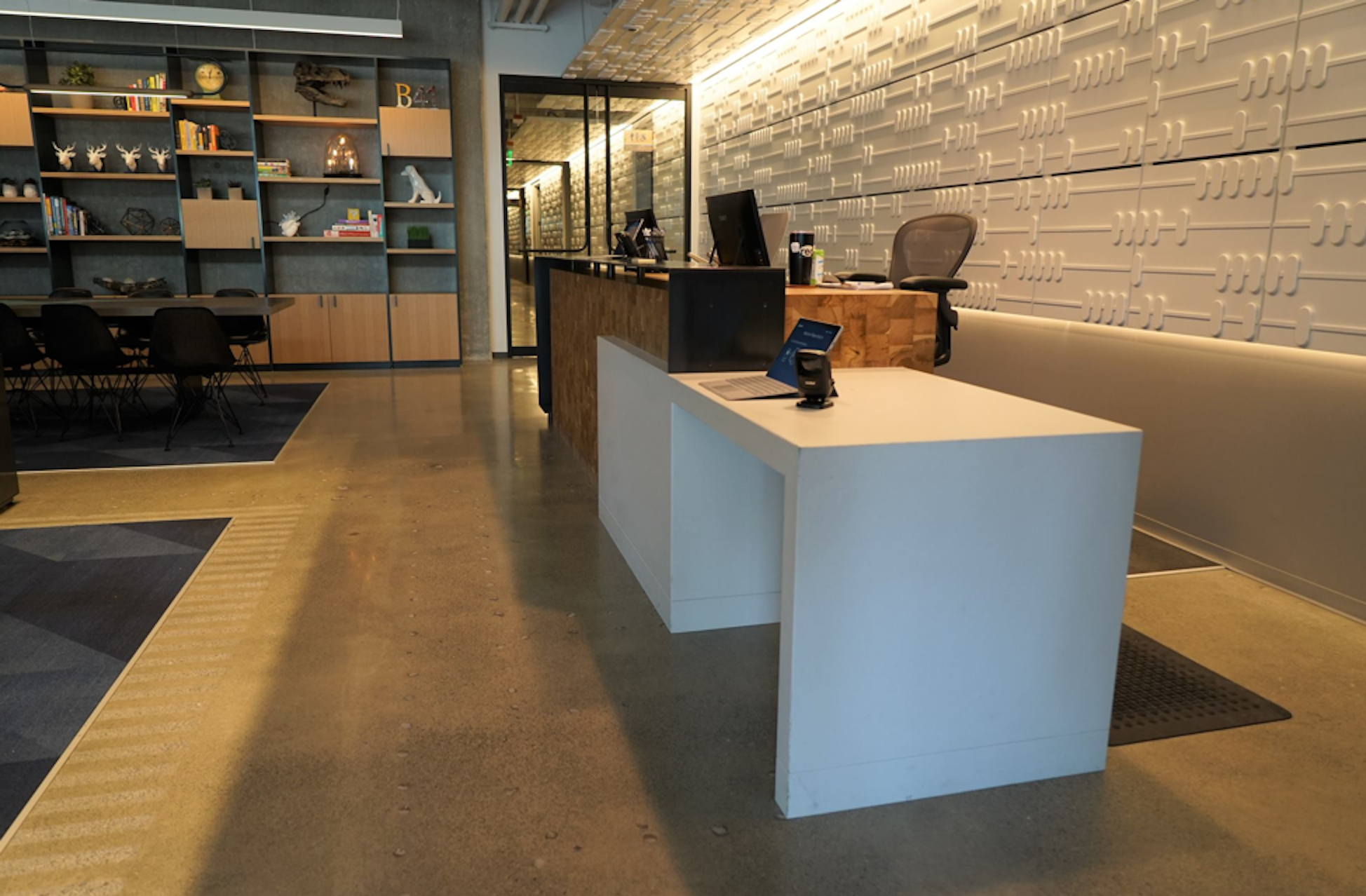
Just inside Building 92, the most public-facing building on Microsoft’s main campus in Redmond, visitors are greeted at a large reception desk. The desk has two surface levels: one at the appropriate height for people arriving on foot, another at the appropriate height for people arriving via wheelchair. It is a striking piece of furniture that floats mid-room like an island. However, this reception desk is meaningful for a different reason. People in a wheelchair can access it from the front, slide their knees beneath it, and comfortably interact with the guest-registration device.
A Microsoft lobby with an accessible reception desk
If you don’t use a wheelchair, you may not know that this degree of accessibility is not the norm. Most companies comply with accessibility legislation or code, mandated across most of the world via standards like the United States’ Americans with Disabilities Act (ADA). In many cases, however, the building code does not go far enough to be inclusive to the needs of everyone.
One visitor in a wheelchair wrote to say they really appreciated being able to wheel in to the reception desk to register:
“I ended up waiting twenty minutes for my appointment to escort me; ; it would’ve been nice to have a place to set up my laptop.”
Of course it would have! Low coffee tables are hard for people to reach to set a drink, let alone work on a device.
Choice. It’s all about choice.
In recent years, a transformation in our company culture has compelled us to reach higher in the areas of inclusivity and accessibility. Inclusion lies at the heart of the mission statement Microsoft CEO Satya Nadella introduced three years ago:
To empower every person and every organization on the planet to achieve more.
For most of the 20th century, people defined disability as the result of an individual’s condition. The person was the problem. Today we know that disability happens at the points of interaction between a person and her/his environment. Physical, cognitive, and social exclusion result from a mismatch between what people want to achieve and an environment that does not support them. This new definition of disability as a mismatch, first adopted by the World Health Organization, presents a solvable design, business, and social challenge….
Please login to read the full article
Unlock over 1000 articles, book reviews and more…